
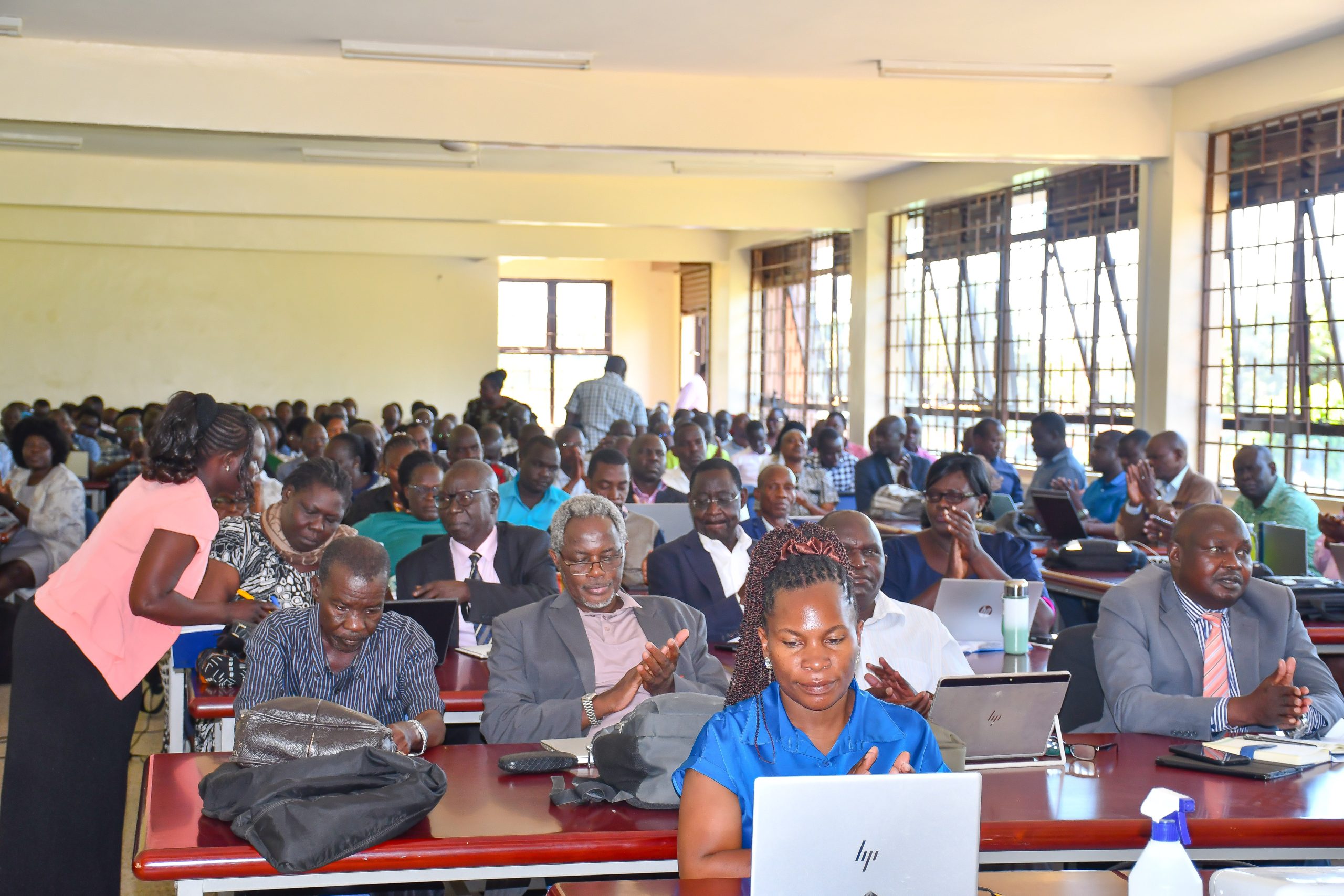
Over 300 Gulu University staff undergo training ahead of CBET rollout in 2027
Daniel Lakwonyero2026-09-07T09:12:08+03:00Gulu University is training more than 300 teaching and non-teaching staff in preparation for Competency-Based Education and Training (CBET) roll out in 2027/2028. The three-day CBET training and retooling workshop for academic and administrative staff which kicked off on Wednesday 2nd and ending Friday 4th September, 2026 seeks to strengthen staff capacity to review and align the university’s existing curricula with the standards of the National Council for Higher Education (NCHE).
The workshop comes as Gulu University prepares for the transition from traditional knowledge or content-based curricula to a competency-based approach. The university, through the Office of the Deputy Vice Chancellor (Academic Affairs), has established a team of CBET Champions drawn from the Faculties of Agriculture and Environment, Medicine, Business and Development Studies, Law, Education and Humanities, Science, and the Institute of Peace and Strategic Studies. The university is also represented on the national CBET taskforce under the Ministry of Education and Sports through the AgriCBE project
Group photo of participants Infront of the New Library.
This latest training builds on an initial four-day Competency-Based Curriculum workshop held in April 2026 at the Gulu University New Library. The earlier training was conducted in collaboration with the Regional Universities Forum for Capacity Building in Agriculture (RUFORUM), the AgriCBE project and the Mastercard Foundation under the Transforming Africa’s Agricultural Institutions to Meaningfully Contribute to Africa’s Growth and Development (TAGDev 2.0) programme.
It formed part of the university’s commitment to adopting competency-based education frameworks in preparation for the national directive requiring higher education institutions to have competence-based curricula by 2027.
While officially opening the workshop on Wednesday, Gulu University Vice Chancellor, Prof. George Ladaah Openjuru, emphasized that the training is not about throwing away the existing curriculum and introducing an entirely new one. Rather, he explained, the university is seeking to retune what is already in place to make education more responsive to the world of work.
He stressed that the ultimate goal is to strengthen the transition from education to employment by ensuring that students are equipped with competencies that can be applied beyond the classroom.
The Vice Chancellor also pointed to the university’s preparations for the 2027/2028 academic intake, when the first cohort of students who have gone through Uganda’s competency-based curriculum at secondary-school level is expected to transition to university emphasizing that universities must prepare adequately for this shift.
“If we continue with the current system, we will fail the students. This curriculum focuses on meaningful integration of students into the world of work simply connecting theories to reality at hand. As an institution, we are set to retune about 85 programs that we currently offer, to drive genuine community transformation as per our motto For Community Transformation,” Prof. Openjuru said.
Prof. George Ladaah Openjuru, VC Gulu University officially opening the workshop on Wednesday
The move to CBET is expected to enhance student learning outcomes, improve graduate employability and ensure that university education responds more effectively to national development priorities. The approach places emphasis on competence development, experiential learning and stronger engagement with World of Work (WOW) partners, helping students connect theory with practical realities.
The workshop has three key objectives: to equip curriculum developers, faculty and institute leaders and academic leaders with practical knowledge in CBET design, implementation and assessment; enable participants to finalize curricula for submission to NCHE; and develop an institutional framework and best practices for the sustainable adoption of CBET at Gulu University.
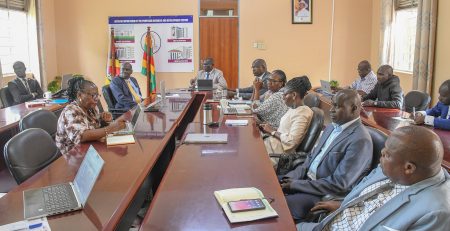
Photo of participants during the training session
University Secretary Mr. David Obol Otori, emphasized that the CBET transition is part of a wider transformation taking place across the universities and is linked to the Ten-Fold Economic Strategy, which is driving reforms across different sectors, including education.
He noted that the reforms go beyond academic departments and encompass several areas of university development, including infrastructure, reading and learning equipment, games and sports, specialized staffing, staff training and promotion.
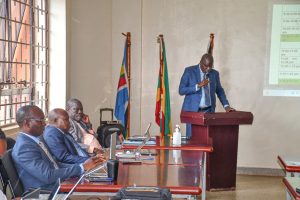
University Secretary Mr. David Obol Otori
Prof. Davy David Okello Owiny, Deputy Vice Chancellor In Charge of Academic Affairs further highlighted the university needs to plan towards strengthening its digital learning infrastructure by increasing internet bandwidth from 380 Mbps to 1 Gbps. The expansion is expected to widen the university’s e-learning capacity and support more effective use of digital resources in teaching and learning.
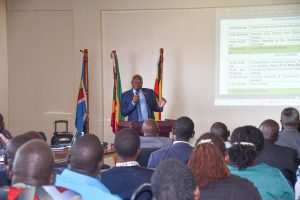
Prof. Davy David Okello Owiny, Deputy Vice Chancellor In Charge of Academic Affairs
The three-day workshop brings together members of top management, academic staff, members of the Committee of Deans, Chiefs and Academic Programmes, registrars and some non-teaching staff.
Facilitators include Assoc. Prof. Basil Mugonola, Principal Investigator of the AgriCBE project and Gulu University representative to the national CBET taskforce, Dr. George Oriangi, a member of the Gulu University CBET Review Taskforce, and Dr. Racheal Nangobi, a member of the AgriCBE project.
Participants are being taken through key areas including competencies and learning outcomes, recognition of prior learning, learning activities, curriculum matrices, learning resources, assessment and curriculum alignment templates. Faculties and institutes also presenting their realigned curricula for discussion and further refinement.
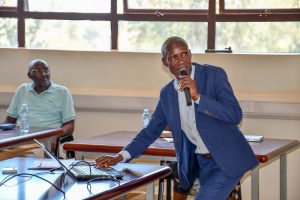
Dr. George Oriangi, Member of the Gulu University CBET Review Taskforce taking participants through learning activities and Curriculum Matrix.
By the end of the three days, the university expects to have strengthened the capacity of academic and administrative staff to develop and implement CBET curricula, completed curricula ready for submission to NCHE, shared institutional frameworks to support competency-based education, and a sustainability plan for CBET rollout and continuous professional development of academic staff.
Dr. Jerry Bagaya, the Academic Registrar clarified to the participants that with Competence Based Curriculum Training (CBET), the existing course structures, knowledge bases and academic standards remain intact but are mapped to specific competencies, skills and industry frameworks to ensure graduates are workplace ready.
“Our curriculum is aligned to the CBET Framework but not changing from teacher centered to CBET. We need to understand this difference as academics and comply with NCHE.” AR clarified.
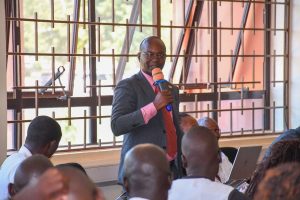
Dr. Jerry Bagaya, the Academic Registrar
Assoc. Prof. Basil Mugonola introduced the team to the backward design approach for the curriculum realignment saying the approach begins with competencies, which include generic competencies, discipline-specific competencies, and program-level competencies, and lastly, learning outcomes.
He emphasized that the major requirement is to ensure that learners can perform effectively in real-life workplaces and society. This involves considering what society needs from students in a particular discipline and identifying who to collaborate with in the world of work to ensure the curriculum responds to those needs.
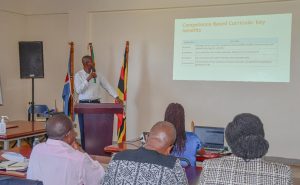
Assoc. Prof. Basil Mugonola, Principal Investigator of the AgriCBE project and Gulu University representative to the national CBET taskforce.
The student-centered curriculum promotes transferable skills that can be applied in diverse settings, thereby contributing to lifelong learning. It is also flexible, allowing students to progress at their own pace based on mastery, while learning can occur through multiple pathways, including formal, informal, and non-formal learning.
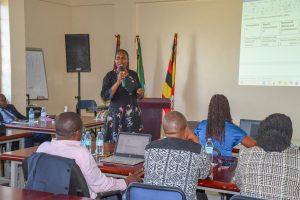
Dr. Racheal Nangobi, a member of the AgriCBE project.
Assessment begins with determining what the learner knows, then examining what the learner can demonstrate, and finally establishing whether the evidence is sufficient to support the judgement.
By maintaining a balance between CBET Frameworks and the current Curriculum, Gulu University preserves its academic foundations while integrating the practical benefits of CBET to students.





Leave a Reply