
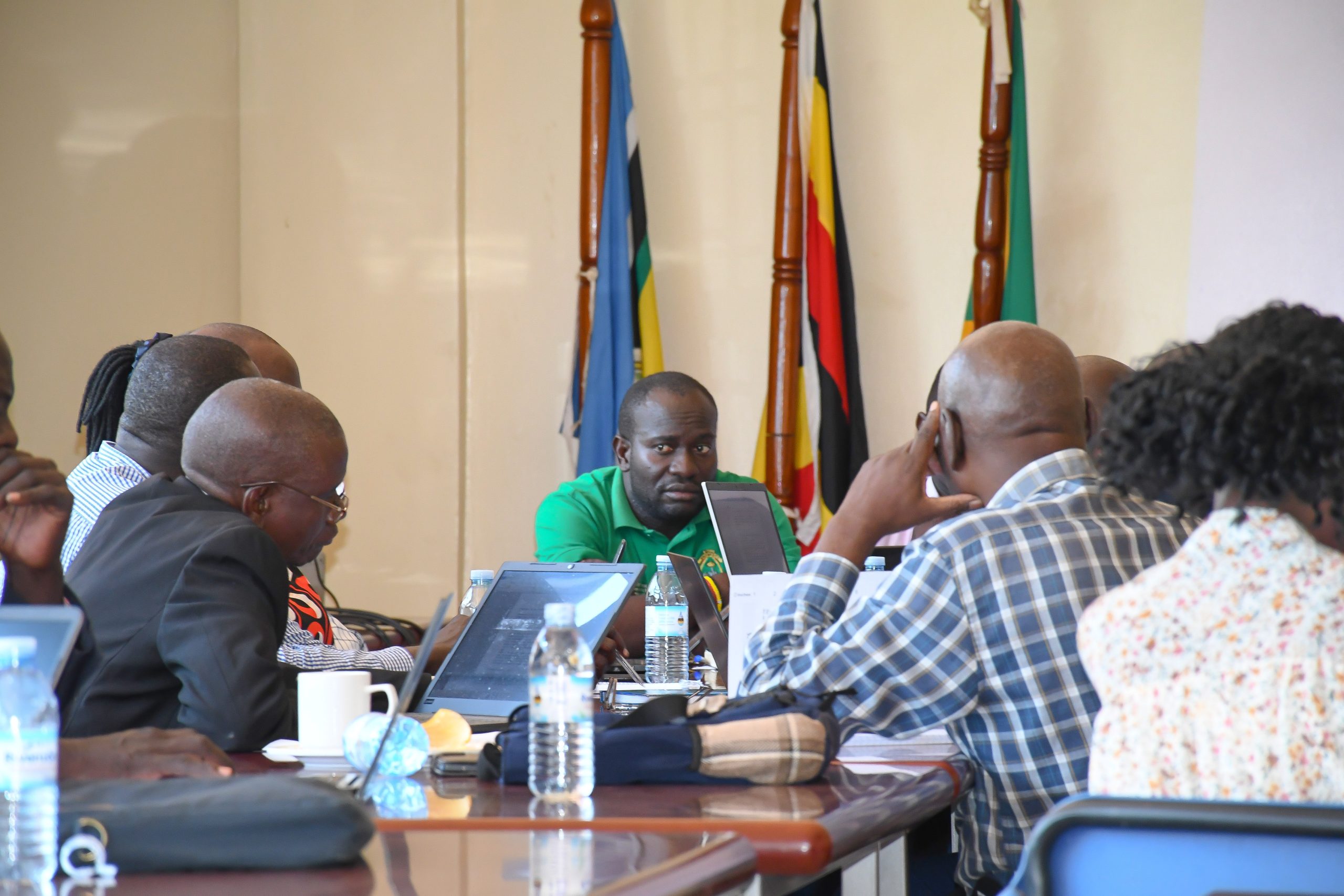
Gulu University Hosts Northern Region Stakeholder Engagement on Draft National STI Policy
Gulu University on Friday,20th November 2026 hosted a one-day Northern Region Stakeholder Engagement on the draft Science, Technology and Innovation (STI) Policy, spearheaded by the Uganda National Council for Science and Technology (UNCST) from the University New Library.
The engagement brought together District Health Officers, Chief Administrative Officers (CAOs), scientists, researchers, and representatives from institutions of higher learning across the Northern Region to discuss and provide input into the development of a comprehensive STI Policy aimed at driving regional and national development.
Speaking at the engagement, Associate Professor Okello Collins, Dean of the Faculty of Agriculture and Environment at Gulu University, who represented the Vice-Chancellor, applauded the Ministry of Science, Technology and Innovation in the Office of the President for entrusting Gulu University with the opportunity to host the important stakeholder engagement.
He commended the Government of Uganda for prioritising science, technology and innovation as key drivers of national development. He also recognised UNCST’s longstanding support to Gulu University, particularly through the Millennium Science Initiative (MSI) Biosystems Engineering Project, funded by the World Bank and the Government of Uganda between 2008 and 2012.
According to Associate Professor Okello, the project played a significant role in strengthening the University’s academic and research capacity through the establishment of the Bachelor of Science in Biosystems Engineering programme. The programme has since produced graduates who are gainfully employed and contributing to job creation, particularly for the youth.
He added that the project also supported the expansion of teaching and training infrastructure, including additional teaching space, equipment and agricultural machinery, notably a tractor and its implements.
Associate Professor Okello further highlighted Gulu University’s growing contribution to science-led innovation and commercialisation, noting that world-class innovations can be developed locally rather than imported.
He explained that, through sustained support for STI and a structured research-to-commercialisation pathway, the University is enabling researchers and students to transform innovative ideas from conceptualisation and testing into practical solutions with real-world impact.
He cited the operationalisation of the Gulu University Cassava Processing Plant as an example of innovation adding direct agro-industrial value to local agricultural produce and creating opportunities for farmers.
He also highlighted the University’s bioscience innovations, including low-cost plant disease diagnostic kits and fly-repellent solutions aimed at protecting livelihoods and livestock.
Other innovations, he noted, include youth-led initiatives in biochar production, plastic recycling and wastewater-to-electricity generation, demonstrating the potential of local research and creativity to address pressing societal and environmental challenges.
Meanwhile, Ms. Immaculate Nakamya, Head of the Science, Technology Policy Coordination Division at UNCST, explained that the stakeholder engagements are intended to ensure equitable opportunities for consultation across the country.
She emphasised that broad-based stakeholder participation is essential in capturing diverse perspectives, experiences and recommendations that will inform the development of a comprehensive, inclusive and responsive Science, Technology and Innovation Policy.
The Northern Region engagement forms part of UNCST’s wider consultation process aimed at gathering input from stakeholders across Uganda to ensure that the proposed STI Policy reflects the country’s development priorities and provides a framework for harnessing science, technology and innovation for sustainable national transformation.






Leave a Reply