
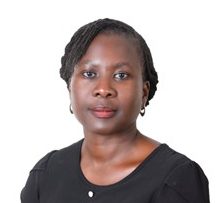
Dr. Julaina A. Obika
Associate Professor- Institute of Peace and Strategic Studies
- Research Ethics Committee
- j.obika@gu.ac.ug
- PhD (GU), MA(Conflict Transformation Studies),(NMMU ) , BA(Social Sciences)(MAK)
- | Google Scholar
Julaina A. Obika is Associate Professor at the Institute of Peace and Strategic Studies, Gulu University, Uganda. Her research examines the intersections of conflict, gender, mobility, and resource governance in post-conflict societies, with a particular focus on northern Uganda and the wider East African region. Drawing on long-term ethnographic engagement, her work explores how ordinary people navigate social transformation in contexts shaped by war, displacement, labour migration, and changing livelihood opportunities.
She has published extensively on land governance and conflict, gender and peacebuilding, labour migration to the Middle East, and regional integration in East Africa. Her recent work has appeared in the Journal of Eastern African Studies, Nordic Journal of African Studies, and Anthropology Today. She is also co-editor of Marriage Matters: Imagining Love and Belonging in Uganda (UCL Press, 2025), which examines changing social relations and aspirations in contemporary Uganda.
Associate Professor Obika leads and contributes to several international collaborative research and teaching initiatives. She is Coordinator of the Erasmus+ funded EU–Africa Relations and Regional Integration in East Africa (EARRIEA) project at Gulu University, Principal Investigator of the Changing In-fertilities in Uganda (CIFU) project, Principal Investigator of the Imagining gender futures in Uganda (IMAGENU) Project, and a researcher with the AfriquEurope consortium as well as the Jean Monnet in Africa Centre of Excellence. Beyond her research, she serves as Chairperson of the Gulu University Research Ethics Committee, where she provides leadership in research ethics governance and mentors emerging scholars in responsible research practices.
Her current research explores how gendered power relations, labour migration, and resource politics reshape belonging, family life, and social transformation in post-conflict Northern Uganda Uganda and across the African continent.